Bucktool vs RIKON Power Tools Disc and Belt Sanders: Which Brand Fits You?
As an Amazon Associate we earn from qualifying purchases. Links on this page are affiliate links.
The bucktool vs RIKON Power Tools disc and belt sander comparison helps you choose the right benchtop sander. Both tools offer a 4x36-inch belt and a 6-inch disc for woodworking projects. They share similar configurations and target materials. The main difference lies in their construction and motor specifications. Bucktool uses a direct-drive design with a 3/4 HP motor. RIKON features a cast iron base and lists specific belt and disc speeds. You need to decide which build quality and performance metrics matter most for your shop.
Key differences
| Aspect | Bucktool 4x36 Belt and 6-Inch Disc Sander | RIKON 4x36-Inch Belt and 6-Inch Disc Sander |
|---|---|---|
| Motor Power | 3/4 HP | not listed |
| Belt Speed | not listed | 1900 SFPM |
| Disc Speed | not listed | 3450 RPM |
| Amperage | 5 A | not listed |
| Base Construction | Cast aluminum | Cast iron and steel |
Which one should you choose?
Choose Bucktool 4x36 Belt and 6-Inch Disc Sander if
- You want a motor rated at 3/4 HP with direct drive efficiency
- You prefer a lighter machine at 35.5 pounds
- You need a belt that tilts from 0 to 90 degrees
Choose RIKON 4x36-Inch Belt and 6-Inch Disc Sander if
- You prioritize heavy-duty cast iron and steel construction for vibration control
- You need known belt speed of 1900 SFPM
- You require a disc speed of 3450 RPM for faster finishing
Verdict: Choose the Bucktool if you value the specified 3/4 HP motor and adjustable belt angle. Pick the RIKON model if you need the stability of a cast iron base and known speed ratings. Both tools provide the same belt and disc sizes for general woodworking tasks.
Bucktool vs Rikon Sander Comparison
Motor and power
The Bucktool BD4603A features a 3/4 HP fully enclosed induction motor drawing 5 amps. Its direct drive design claims to be 25% more efficient than traditional setups, maximizing motor development for quiet performance. The Rikon 50-112 does not list its motor horsepower or amperage in the provided specifications. It only specifies a direct drive for increased torque and reliability. Without explicit power ratings for the Rikon, you cannot directly compare the raw power output or electrical draw of the two machines. The Bucktool provides more concrete data regarding its electrical requirements and motor type, which helps in planning your workshop power supply.
Belt and disc speeds
Speed is critical for finish quality. The Rikon 50-112 lists specific operational speeds: the belt runs at 1900 SFPM, and the disc rotates at 3450 RPM. These fixed speeds help you predict how fast material will be removed. The Bucktool BD4603A does not provide belt or disc speed data in its specifications. While it mentions a direct drive system, the absence of RPM or SFPM figures means you cannot verify if the cutting speed matches your needs for fine sanding or aggressive stock removal. For users who rely on specific speed settings for different materials, the Rikon offers more transparent performance metrics.
Build and construction
Both machines prioritize stability, but they use different materials. The Rikon 50-112 is built with a cast iron and steel construction, featuring a heavy-duty base designed to provide vibration-free operation. This suggests a focus on rigidity and durability for heavy use. The Bucktool BD4603A uses a sturdy cast aluminum base with rubber feet to prevent vibrations. It also includes two cast aluminum worktables. Aluminum is lighter than cast iron, which may affect the overall weight. The Bucktool weighs 35.5 pounds, while the Rikon weighs 38.6 pounds. The Rikon’s cast iron base may offer superior dampening for heavy-duty woodworking tasks.
Table adjustability
Versatility in sanding angles matters for complex projects. The Bucktool BD4603A allows the belt to tilt from 0 to 90 degrees, supporting both horizontal and vertical sanding. It also includes a quick replacement design and track control function. The Rikon 50-112 specifications do not mention any tilt range or angle adjustments for the belt or disc. It only lists the belt and disc sizes. If you need to sand edges at specific angles or work on curved pieces, the Bucktool’s adjustable table provides clear functional advantages. The Rikon appears to offer a fixed-angle setup based on the available data.
Dimensions and footprint
Space in your workshop is limited. The Bucktool BD4603A measures 23.8 inches in length, 11.6 inches in width, and 20.5 inches in height. The Rikon 50-112 is slightly more compact, measuring 21 inches in length, 10 inches in width, and 11 inches in height. The Rikon’s smaller footprint might fit better on smaller benches. However, the Bucktool’s height is nearly double that of the Rikon, which could affect ergonomics depending on your workbench height. Both machines are benchtop configurations, but the Rikon is shorter and narrower, potentially offering easier storage or placement in tight spaces.
Choose the right sander for you
Users needing adjustable sanding angles
The Bucktool BD4603A allows the belt to tilt from 0 to 90 degrees. This feature supports both horizontal and vertical sanding tasks. You can also sand curved workpieces using the driven drum. The quick belt replacement and track control function simplify maintenance. This flexibility makes it ideal for complex woodworking projects that require varied surface orientations.
Buyers prioritizing heavy-duty construction
The Rikon 50-112 features a cast iron and steel base. This heavy-duty construction provides vibration-free operation during use. Weighing 38.6 pounds, it offers more stability than the lighter Bucktool. The direct drive disc delivers increased torque and reliability. If you prefer a robust build that minimizes shake, this sander is the better choice for steady performance.
Those wanting fast belt speed
The Rikon 50-112 operates the belt at 1900 SFPM. This speed helps finish workpieces quickly with smooth results. The disc runs at 3450 RPM for direct drive efficiency. While the Bucktool emphasizes motor efficiency claims, the Rikon provides specific speed metrics. If you value known belt speeds for faster material removal, this model offers clear performance data.
The products compared
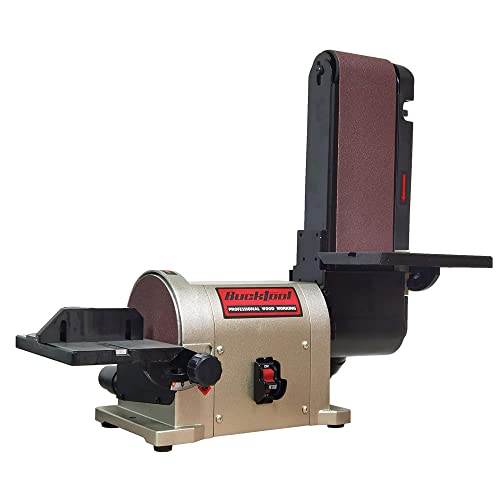
Bucktool 4x36 Belt and 6-Inch Disc Sander
Best for: maintenance-free belt sanding with angle adjustments
- Belt Size
- 4 x 36 in.
- Disc Diameter
- 6 in.
- Motor Power
- 3/4 HP
- Amperage
- 5A
- Belt Speed
- 2161 FPM
- Disc Speed
- 3450 RPM
View on Amazon: Bucktool 4x36 Belt and 6-Inch Disc Sander Affiliate link
This bench sander combines a 4x36-inch belt and a 6-inch disc in one unit. It uses a 3/4 HP, 5A motor with a direct-drive design that eliminates belt tension adjustments. The belt tilts from 0 to 90 degrees for angled work. You get two cast aluminum tables and a sturdy base to reduce vibration. It suits woodworkers needing versatile, maintenance-free sanding for flat and curved pieces.
Pros
- Direct-drive motor design removes the need for belt tension adjustments
- Belt tilts from 0 to 90 degrees for multi-angle sanding
- Includes two cast aluminum worktables for different sanding tasks
- 3/4 HP motor provides quiet but powerful performance
Cons
- Limited to 6-inch disc diameter
- No variable speed control listed
- Single fixed speed operation
Good fit if
- You need a maintenance-free belt that does not require tensioning
- You frequently sand at angles up to 90 degrees
- You want a single machine for both belt and disc tasks
Skip if
- You require variable speed settings for delicate materials
- You need a disc larger than 6 inches
- You prefer a machine with digital displays or smart features
Verdict: Bucktool 4x36 Belt 6 Disc Bench Sander fits woodworkers who want a low-maintenance tool with a tilting belt and dual sanding surfaces. It is ideal for general woodworking projects where angle adjustments are necessary.

RIKON 4x36-Inch Belt and 6-Inch Disc Sander
Best for: Stable benchtop sanding with direct drive
- Belt Size
- 4-Inch x 36-Inch
- Disc Diameter
- 6-Inch
- Belt Speed
- 1900 SFPM
- Disc Speed
- 3450 RPM
- Disc Size
- 6-Inch Disc
- Dimensions
- 21 × 10 × 11 inches
View on Amazon: RIKON 4x36-Inch Belt and 6-Inch Disc Sander Affiliate link
The Rikon 50-112 combines a 4-inch by 36-inch belt with a 6-inch disc. It runs the belt at 1900 SFPM and the disc at 3450 RPM. The cast iron and steel base helps reduce vibration during use. This machine suits woodworkers who need a sturdy benchtop unit for smoothing and shaping. Its 38.6-pound weight keeps it stable on your workbench.
Pros
- Cast iron and steel construction for stability
- Belt speed of 1900 SFPM for fast finishing
- Disc speed of 3450 RPM for direct drive torque
- Heavy 38.6-pound base reduces vibration
Cons
- Single belt speed limits fine-tuning for delicate materials
- No variable speed control for the disc mentioned
- Large footprint requires significant bench space
Good fit if
- You need a heavy-duty base to minimize vibration
- You work with standard 4x36 belts and 6-inch discs
- You prefer direct drive reliability over variable speed
Skip if
- You require variable speed settings for different materials
- You have limited bench space under 21 inches
- You need a lightweight sander for portability
Verdict: RIKON 50-112 4x36 Belt Disc Sander fits users who prioritize stability and direct drive reliability over variable speed adjustments. Its heavy build ensures smooth operation for standard woodworking tasks.
Specifications side by side
| Spec | Bucktool 4x36 Belt and 6-Inch Disc Sander | RIKON 4x36-Inch Belt and 6-Inch Disc Sander |
|---|---|---|
| Belt Size | 4 x 36 in. | 4-Inch x 36-Inch |
| Disc Diameter | 6 in. | 6-Inch |
| Motor Power | 3/4 HP | not stated |
| Amperage | 5A | not stated |
| Belt Speed | 2161 FPM | 1900 SFPM |
| Disc Speed | 3450 RPM | 3450 RPM |
| Belt Tilt Range | 0 to 90 degrees | not stated |
| Configuration | Bench | not stated |
| Features | Miter Gauge | not stated |
| Target Material | Wood | not stated |
| Cutting Width | 6-Inch | 6-Inch |
| Application | Woodworking | not stated |
| Disc Size | 6-Inch Disc | 6-Inch Disc |
| Dimensions | 23.8 × 11.6 × 20.5 inches | 21 × 10 × 11 inches |
| Weight | 35.5 pounds | 38.6 pounds |
| Size | 4x36in Belt & 6in Disc | 4″ x 36″ |
| Model | BD4603A | 50-112 |
| Color | not stated | Blue |
Frequently asked questions
Which sander is lighter for moving around the shop?
The Bucktool BD4603A weighs 35.5 pounds, making it the lighter option. The Rikon 50-112 is heavier at 38.6 pounds. You should choose the Bucktool if you need to relocate the tool frequently. The lower weight reduces strain during transport.
How do the physical dimensions compare between the two models?
The Bucktool measures 11.6 inches wide by 20.5 inches high. The Rikon is narrower at 10 inches wide but shorter at 11 inches high. Consider your bench space carefully. The Bucktool has a larger footprint in height, while the Rikon is more compact vertically.
Do both sanders use the same belt size?
Yes, both units use a 4 by 36-inch belt. This is a standard size for benchtop sanders. You can find replacement belts easily for either model. This shared specification means your existing belt inventory works for both the Bucktool and the Rikon.
What disc size do these machines support?
Both the Bucktool BD4603A and the Rikon 50-112 feature a 6-inch disc. This provides ample surface area for sanding curved or flat wood edges. The disc size is identical, so you do not need to change your disc sanding habits when switching brands.
Is the Bucktool belt capable of tilting?
Yes, the Bucktool belt tilts from 0 to 90 degrees. This allows for precise angled sanding on workpieces. The Rikon model does not list angle adjustments in its specifications. If you frequently sand bevels, the Bucktool offers more versatility without extra attachments.
Which brand is better for users prioritizing stability?
The Rikon 50-112 is heavier and described as stable for benchtop use. Its 38.6-pound weight helps dampen vibration during operation. You should choose the Rikon if you want a solid, heavy-duty feel. The Bucktool is lighter, which may affect stability for some users.
Can I use these sanders for general woodworking tasks?
Both tools are explicitly designed for woodworking applications. They handle wood materials effectively with their respective belt and disc configurations. The Bucktool is noted for maintenance-free operation, while the Rikon offers direct drive reliability. Either choice fits standard woodworking projects well.