Best Disc and Belt Sanders with 4" X 36" in 2026: 5 Picks Ranked by Specs
As an Amazon Associate we earn from qualifying purchases. Links on this page are affiliate links.
Finding the best disc and belt sanders with 4 x 36 requires looking at hard specs rather than marketing claims. This guide compares 5 models based on the specifications published on their listings. The Woodskil 4x36 Belt and 6-Inch Disc Sander leads because its 3 Amp motor and 6-inch disc size offer a balanced setup for angle sanding and dust extraction.
Each pick addresses specific needs, from variable speed control to compact benchtop designs. You can use these rankings to decide which machine fits your workspace and material requirements. Focus on belt size, motor power, and disc dimensions to ensure the tool matches your workflow.
Quick picks
| # | Product | Best for | Price |
|---|---|---|---|
| 1 | Woodskil 4x36 Belt and 6-Inch Disc Sander Best overall | Angle sanding and dual dust extraction | Check price of Woodskil 4x36 Belt and 6-Inch Disc Sander on Amazon |
| 2 | Bucktool 4x36 Belt and 6-Inch Disc Sander Best budget | Space-conscious woodworkers needing low maintenance | Check price of Bucktool 4x36 Belt and 6-Inch Disc Sander on Amazon |
| 3 | BUCKTOOL 1HP VFD 4x36 Belt 8 Disc Sander Best premium | Variable speed heavy-duty sanding | Check price of BUCKTOOL 1HP VFD 4x36 Belt 8 Disc Sander on Amazon |
| 4 | RIKON 4x36-Inch Belt and 6-Inch Disc Sander Also great | Heavy-duty general woodworking sanding | Check price of RIKON 4x36-Inch Belt and 6-Inch Disc Sander on Amazon |
| 5 | WEN 6-Inch Jointer and Belt Disc Sander Combo Best 10 amp | basic belt and disc sanding tasks | Check price of WEN 6-Inch Jointer and Belt Disc Sander Combo on Amazon |
The best fit for you
- You need angle sanding and dust extraction Woodskil 4x36 Belt and 6-Inch Disc Sander Its 4.3A motor and fixed 1732 fpm speed support angle adjustability and dust management.
- You want the most compact model on the list WEN 6-Inch Jointer and Belt Disc Sander Combo The benchtop configuration and 10 Amp motor provide a stable, compact solution for basic tasks.
- You require variable speed for heavy-duty work BUCKTOOL 1HP VFD 4x36 Belt 8 Disc Sander The 1 HP VFD motor and variable speed settings allow for precision in heavy-duty sanding.
- You prioritize a heavy, vibration-free base RIKON 4x36-Inch Belt and 6-Inch Disc Sander Its 38.6 pound weight and direct-drive power ensure a stable, vibration-free base for general work.
Our 5 picks

Woodskil 4x36 Belt and 6-Inch Disc Sander
Best for: Angle sanding and dual dust extraction
- Belt Size
- 4" x 36" (what this guide is about)
- Disc Diameter
- 6"
- Motor Power
- 3/4 HP
- Amperage
- 4.3A
- Belt Speed
- 1732 FPM
- Disc Speed
- 3570 RPM
View on Amazon: Woodskil 4x36 Belt and 6-Inch Disc Sander Affiliate link
This benchtop sander combines a 4x36 inch belt and a 6 inch disc. It uses a 3/4 HP motor to reach 1732 fpm on the belt and 3570 rpm on the disc. The belt tilts from 0 to 90 degrees, and the table adjusts from 0 to 45 degrees. It includes dual dust ports for separate exhaust. This setup suits woodworkers needing adjustable angles and efficient dust collection.
Pros
- 3/4 HP motor delivers 1732 fpm belt speed
- Belt tilts 0-90 degrees for vertical sanding
- Dual dust exhaust ports for belt and disc
- Table adjusts 0-45 degrees with miter gauge
Cons
- Fixed speed limits versatility for delicate materials
- 4.3A motor is less powerful than 1HP competitors
- 25-pound weight adds bulk to small workspaces
Good fit if
- You need to sand at steep angles
- You want separate dust collection for each sander
- You work primarily with wood projects
Skip if
- You require variable speed control for fine finishes
- You need a motor stronger than 3/4 HP
- You prefer a lighter benchtop unit under 20 pounds
Verdict: Woodskil 4x36 Belt Disc Sander 4.3A fits users who prioritize angle adjustability and dust management over variable speed precision. Its fixed 1732 fpm belt speed and 3/4 HP motor make it a solid tool for standard woodworking tasks.
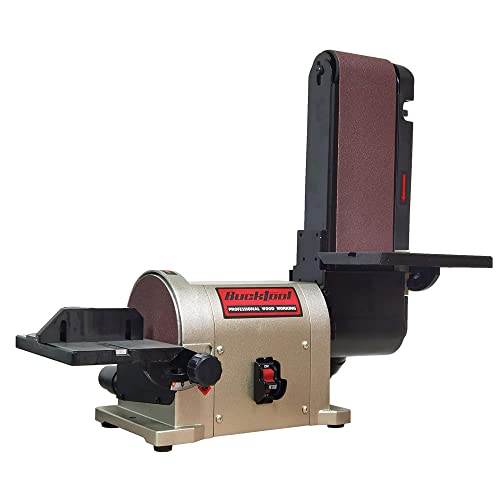
Bucktool 4x36 Belt and 6-Inch Disc Sander
Best for: Space-conscious woodworkers needing low maintenance
- Belt Size
- 4" x 36" (what this guide is about)
- Disc Diameter
- 6 in.
- Motor Power
- 3/4 HP
- Amperage
- 5A
- Belt Speed
- 2161 FPM
- Disc Speed
- 3450 RPM
View on Amazon: Bucktool 4x36 Belt and 6-Inch Disc Sander Affiliate link
This benchtop sander combines a 4 x 36-inch belt and a 6-inch disc. It uses a 3/4 HP motor that drives the belt and disc directly. The design saves space and increases efficiency. The belt tilts from 0 to 90 degrees. You get cast aluminum tables for stability. It suits woodworkers who want a compact, maintenance-free tool for general shaping.
Pros
- Direct drive motor design for 25% higher efficiency
- No belt tension adjustment required
- Belt tilts 0 to 90 degrees for multi-angle sanding
- Cast aluminum worktables reduce vibration
Cons
- Smaller 6-inch disc compared to 8-inch options
- Lower 3/4 HP motor power than 1 HP competitors
- Heavier 35.5 lb build for a benchtop unit
Good fit if
- You need a compact sander for small workshops
- You want to avoid belt tension adjustments
- You require a belt that tilts for curved work
Skip if
- You need a large 8-inch disc for wide sanding
- You require maximum motor power for heavy stock removal
- You prefer a lighter, portable machine under 25 lbs
Verdict: Bucktool 4x36 Belt Disc Sander fits hobbyists who value low maintenance and space efficiency over raw power or large disc size. It is a practical, stable base for light to medium woodworking tasks.

BUCKTOOL 1HP VFD 4x36 Belt 8 Disc Sander
Best for: Variable speed heavy-duty sanding
- Belt Size
- 4" x 36" (what this guide is about)
- Disc Diameter
- 8 in.
- Motor Power
- 1 HP
- Belt Speed
- 575–2300 SFPM
- Disc Speed
- 900–3600 RPM
- Configuration
- Benchtop
View on Amazon: BUCKTOOL 1HP VFD 4x36 Belt 8 Disc Sander Affiliate link
This benchtop sander pairs a 4x36-inch belt with an 8-inch disc. It uses a 1 HP VFD motor to deliver variable speeds from 900 to 3600 RPM. The belt runs at 575–2300 SFPM. You get precise angle control with a 0–60° miter gauge and 0–45° disc table. The memory function retains your speed settings. It suits users needing heavy-duty performance on wood or metal.
Pros
- 1 HP VFD motor provides high torque at low speeds.
- Variable belt speed ranges from 575 to 2300 SFPM.
- 8-inch disc offers more surface area than standard 6-inch models.
- Speed memory function retains your last setting on restart.
- Supports both horizontal and vertical sanding configurations.
Cons
- VFD motor may trip GFCI outlets, requiring an HACR circuit breaker.
- Belt speed maximum (2300 SFPM) is lower than some fixed-speed competitors.
- No mention of a built-in dust collection port in the provided data.
Good fit if
- You need variable speed control for different materials.
- You want an 8-inch disc for wider sanding tasks.
- You require high torque for heavy metal or wood work.
Skip if
- You only use GFCI-protected outlets without HACR breakers.
- You prefer a simpler fixed-speed machine with fewer controls.
- You need a belt speed exceeding 2300 SFPM.
Verdict: BUCKTOOL 1HP VFD 4x36 Belt Disc Sander fits professionals who need variable speed precision and an 8-inch disc. It is not for users restricted to GFCI outlets or those needing higher belt speeds.

RIKON 4x36-Inch Belt and 6-Inch Disc Sander
Best for: Heavy-duty general woodworking sanding
- Belt Size
- 4" x 36" (what this guide is about)
- Disc Diameter
- 6-Inch
- Belt Speed
- 1900 SFPM
- Disc Speed
- 3450 RPM
- Disc Size
- 6-Inch Disc
- Dimensions
- 21 × 10 × 11 inches
View on Amazon: RIKON 4x36-Inch Belt and 6-Inch Disc Sander Affiliate link
The Rikon 50-112 combines a 4-inch by 36-inch belt with a 6-inch disc. It runs at 1900 SFPM for the belt and 3450 RPM for the disc. The heavy cast iron base reduces vibration during use. This benchtop sander suits woodworkers who need stable, direct-drive performance for smoothing and shaping tasks.
Pros
- Cast iron and steel construction for stability
- 1900 SFPM belt speed for efficient material removal
- 3450 RPM direct-drive disc for high torque
- Heavy 38.6-pound base minimizes vibration
Cons
- Fixed single speed on both belt and disc
- No variable speed control for delicate materials
- No dust collection port mentioned in specs
Good fit if
- You need a heavy, stable base for precision work
- You prefer direct-drive reliability over variable speed
- You want a simple, durable tool for general sanding
Skip if
- You require variable speed for fine detail work
- You need a compact unit under 30 pounds
- You want integrated dust collection features
Verdict: Rikon 50-112 4x36 Belt Disc Sander fits users who prioritize a heavy, vibration-free base and direct-drive power over adjustable speeds.

WEN 6-Inch Jointer and Belt Disc Sander Combo
Best for: basic belt and disc sanding tasks
- Belt Size
- 4" x 36" (what this guide is about)
- Disc Diameter
- 6 in.
- Amperage
- 4.3-Amp
- Disc Speed
- up to 3600 RPM
- Belt Tilt Range
- 0 to 90 degrees
- Configuration
- Benchtop
View on Amazon: WEN 6-Inch Jointer and Belt Disc Sander Combo Affiliate link
The WEN 6502T combines a 4 x 36 inch belt and a 6 inch disc in one benchtop unit. Its 4.3 amp motor drives the belt at up to 3600 RPM. The belt tilts from 0 to 90 degrees for angled sanding. A cast iron base helps reduce vibration. This two-in-one sander suits woodworkers who need a compact machine for general shaping and finishing tasks.
Pros
- 4 x 36 inch belt size matches standard guide criteria
- Belt tilts 0 to 90 degrees for angled work
- Cast iron base reduces vibration
- 6 inch disc included for flat surface work
Cons
- Single speed motor limits sanding control
- 4.3 amp motor is less powerful than 1 HP competitors
- No variable speed adjustment visible in specs
Good fit if
- You need a single unit for belt and disc sanding
- You work with standard 4 x 36 inch belts
- You want a stable cast iron base
Skip if
- You require variable speed control for delicate materials
- You need a more powerful motor for heavy stock removal
- You prefer an 8 inch disc for wider workpieces
Verdict: WEN 4x36 Belt and 6 in Disc Sander offers a stable, compact solution for basic sanding tasks. It fits hobbyists who prioritize belt versatility over high-speed precision.
Specifications side by side
| Spec | Woodskil 4x36 Belt and 6-Inch Disc Sander | Bucktool 4x36 Belt and 6-Inch Disc Sander | BUCKTOOL 1HP VFD 4x36 Belt 8 Disc Sander | RIKON 4x36-Inch Belt and 6-Inch Disc Sander | WEN 6-Inch Jointer and Belt Disc Sander Combo |
|---|---|---|---|---|---|
| Belt Size | 4" x 36" | 4 x 36 in. | 4 x 36 in. | 4-Inch x 36-Inch | 4 x 36 in. |
| Disc Diameter | 6" | 6 in. | 8 in. | 6-Inch | 6 in. |
| Motor Power | 3/4 HP | 3/4 HP | 1 HP | not stated | not stated |
| Amperage | 4.3A | 5A | not stated | not stated | 4.3-Amp |
| Belt Speed | 1732 FPM | 2161 FPM | 575–2300 SFPM | 1900 SFPM | not stated |
| Disc Speed | 3570 RPM | 3450 RPM | 900–3600 RPM | 3450 RPM | up to 3600 RPM |
| Belt Tilt Range | 0-90 degrees | 0 to 90 degrees | not stated | not stated | 0 to 90 degrees |
| Configuration | Benchtop | Bench | Benchtop | not stated | not stated |
| Swing | not stated | not stated | 8-Inch | not stated | not stated |
| Speed Settings | not stated | not stated | Variable Speed | not stated | not stated |
| Features | Miter Gauge | Miter Gauge | not stated | not stated | not stated |
| Target Material | Wood | Wood | Wood | not stated | not stated |
| Cutting Width | 6-Inch | 6-Inch | not stated | 6-Inch | 6-Inch |
| Cutterhead Style | not stated | not stated | not stated | not stated | Spiral Cutterhead |
| Application | Woodworking | Woodworking | Woodworking | not stated | not stated |
| Disc Size | 6-Inch Disc | 6-Inch Disc | not stated | 6-Inch Disc | 6-Inch Disc |
| Dimensions | 16.9 × 9.8 × 15.6 inches | 23.8 × 11.6 × 20.5 inches | 23.2 × 14.2 × 20.1 inches | 21 × 10 × 11 inches | not stated |
| Weight | 25 pounds | 35.5 pounds | not stated | 38.6 pounds | not stated |
| Size | Belt: 4" x 36", Disc: 6", 4.3A | 4x36in Belt & 6in Disc | 4" x 36" Belt & 8" Disc & 1HP VFD | 4″ x 36″ | not stated |
| Color | Yellow | not stated | not stated | Blue | not stated |
| Model | 610452351737 | BD4603A | not stated | 50-112 | JT630H, 6502T |
How to choose the right one
-
Check motor power needs
Motor amperage indicates the tool's capacity to handle resistance. Higher amperage generally means more torque for dense materials. The WEN model features a 10 Amp motor, offering robust power for demanding tasks. In contrast, the Woodskil unit has a 3 Amp rating, which suits lighter, routine work. Match the amperage to your typical workload. If you sand hardwoods frequently, a higher amp rating prevents stalling. For occasional hobby use, a lower amp unit is sufficient and often lighter.
-
Evaluate disc size options
The disc diameter determines the maximum width of flat surfaces you can sand efficiently. Most models on this list feature a 6-inch disc, which is standard for general woodworking. The Bucktool premium model stands out with an 8-inch disc, allowing you to handle wider boards without frequent repositioning. A larger disc also tends to last longer between changes due to its increased surface area. Choose an 8-inch disc if you work with wide stock regularly. Otherwise, a 6-inch disc provides ample versatility for most projects.
-
Consider variable speed control
Speed settings allow you to match the belt speed to the material type. Variable speed drives, like the VFD in the Bucktool premium model, let you adjust the belt for delicate finishes or aggressive stock removal. Fixed-speed models, such as the Woodskil and Rikon, run at a constant rate. This is fine for standard wood but limits precision on sensitive materials. If you need to switch between fine sanding and heavy grinding, variable speed is essential. For consistent, single-purpose tasks, fixed speed simplifies operation.
-
Assess weight and stability
Heavier machines vibrate less during operation, resulting in smoother finishes. The Rikon sander weighs 38.6 pounds, providing a solid, vibration-free base for heavy-duty work. The Woodskil model is lighter at 25 pounds, making it easier to move but potentially less stable under load. Consider where you will place the tool. A heavy benchtop unit may require a sturdy workbench. If you need portability, a lighter model is better, but you may need to clamp it securely to prevent movement.
-
Review physical dimensions
Footprint and height determine if the sander fits your workspace. The Bucktool budget model is tall at 20.5 inches and deep at 23.8 inches, requiring significant vertical and horizontal space. The Woodskil is more compact, measuring 15.6 inches high. Measure your bench or cabinet before purchasing. Ensure you have room for the disc overhang and belt access. A smaller footprint is ideal for small shops. Larger dimensions often correlate with better dust collection and stability, so balance space constraints with performance needs.
Frequently asked questions
Which 4x36 sander has the largest disc size?
The Bucktool 1HP VFD model features an 8-inch disc, which is the largest on this list. Most other options, including the Woodskil and Rikon models, come with a standard 6-inch disc. The larger disc allows for wider surface area coverage and different sanding angles. This makes the premium Bucktool suitable for professionals needing extra capacity.
What is the difference between fixed and variable speed sanders?
Fixed speed sanders run at a constant belt speed, such as the Woodskil unit at 1732 fpm. Variable speed models, like the Bucktool 1HP VFD, let you adjust the speed for different materials. Fixed speeds are simpler and often more durable for standard woodworking. Variable speeds offer precision for delicate tasks or harder materials, giving you more control.
How much space does a 4x36 belt disc sander take up?
These units vary significantly in footprint. The WEN benchtop model is the most compact, designed to fit on a workbench. The Rikon model is heavier and larger, weighing 38.6 pounds. The Woodskil measures 16.9 inches in length. You should measure your workspace carefully, as the base dimensions and height differ between the compact benchtop and heavier floor-standing styles.
Which sander is best for angle sanding?
The Woodskil 4x36 Belt and 6-Inch Disc Sander is highlighted for angle sanding capabilities. It includes features that support tilting the table for bevels. This adjustability is useful for edge work and intricate shapes. Other models prioritize raw power or space efficiency over this specific feature, making the Woodskil the top choice for users who need versatile angle adjustments.
Does the WEN sander function as a jointer too?
Yes, the WEN model is a 6-Inch Jointer and Belt Disc Sander Combo. It combines belt sanding, disc sanding, and jointing capabilities in one unit. This configuration is ideal for hobbyists who want a stable, compact solution for basic tasks. It offers belt versatility alongside jointing functions, making it a multi-purpose tool for smaller workshops.
Which model is heaviest and most stable?
The Rikon 4x36-Inch Belt and 6-Inch Disc Sander is the heaviest, weighing 38.6 pounds. Its substantial weight contributes to a vibration-free base, which is crucial for precision sanding. The Bucktool budget model follows at 35.5 pounds. The heavier construction helps absorb motor vibrations, providing a smoother sanding experience compared to lighter, more portable units.