Best Jointers Under $500 in 2026: 2 Picks Ranked by Specs
As an Amazon Associate we earn from qualifying purchases. Links on this page are affiliate links.
You need reliable best jointers under $500 to finish lumber properly. We compared 2 models using only the specifications published on their listings. The Wahuda 6-Inch Spiral Benchtop Jointer leads because its spiral cutterhead design reduces noise and vibration. This makes it ideal for small shop woodworking and narrow boards. Each pick in this guide is ranked strictly by published data like amperage, cutting width, and dimensions. This approach removes guesswork from your selection. Use these rankings to decide which machine fits your workspace and material needs.
Quick picks
| # | Product | Best for | Price |
|---|---|---|---|
| 1 | Wahuda 6-Inch Spiral Benchtop Jointer Best overall | Small shop woodworking and narrow boards | Check price of Wahuda 6-Inch Spiral Benchtop Jointer on Amazon |
| 2 | WEN 8-Inch Spiral Jointer with Extendable Table Best budget | Users needing 8-inch capacity in a benchtop form | Check price of WEN 8-Inch Spiral Jointer with Extendable Table on Amazon |
The best fit for you
- You need the most compact benchtop jointer available Wahuda 6-Inch Spiral Benchtop Jointer It measures 14 inches wide and 13 inches high, making it the smallest footprint on the list.
- You want to plane wider boards up to 8 inches WEN 8-Inch Spiral Jointer with Extendable Table Its 8-inch swing capacity allows you to handle medium-width lumber that exceeds the 6-inch limit.
- You prefer a quiet spiral cutterhead design for both tools Wahuda 6-Inch Spiral Benchtop Jointer Both models feature spiral cutterheads, but this option offers the best overall balance for small shops.
Our 2 picks

Wahuda 6-Inch Spiral Benchtop Jointer
Best for: Small shop woodworking and narrow boards
- Cutting Width
- 6-inch
- Cutterhead Style
- Spiral
- Configuration
- Benchtop
- Motor Power
- 10amp
- Voltage
- 120V
- Fence Tilt
- 90° to 135°
View on Amazon: Wahuda 6-Inch Spiral Benchtop Jointer Affiliate link
This 6-inch benchtop jointer features a spiral cutterhead with 4-sided carbide inserts for quieter, precise cuts. It uses a 10-amp motor running at 12,000 RPM to handle flattening and edging tasks. The cast iron tables provide stability, and the fence tilts from 90 to 135 degrees. It is designed for small shops or job sites where portability matters.
Pros
- Spiral cutterhead with 4-sided carbide inserts
- 10-amp motor with 12,000 RPM speed
- Tilting fence from 90 to 135 degrees
- Cast iron tables for stability
Cons
- 6-inch cutting width limits board capacity
- Heavier and bulkier than compact models
- Fixed 12,000 RPM speed lacks variable control
Good fit if
- You need a portable jointer for small shops
- You want quieter operation from a spiral head
- You work with wood up to 6 inches wide
Skip if
- You require variable speed control
- You frequently joint boards wider than 6 inches
- You need a heavy-duty industrial machine
Verdict: Wahuda Tools 6-Inch Benchtop Jointer suits hobbyists needing a portable, quiet tool for narrow boards. It delivers solid performance for small-scale woodworking projects without taking up much space.
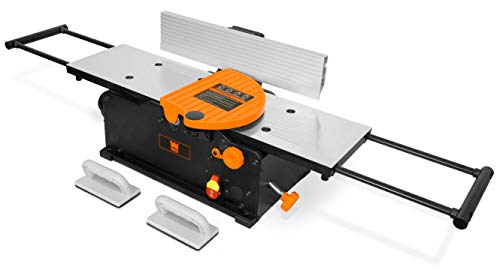
WEN 8-Inch Spiral Jointer with Extendable Table
Best for: Users needing 8-inch capacity in a benchtop form
- Cutting Width
- 8"
- Cutterhead Style
- Spiral
- Configuration
- Benchtop
- Motor Power
- 10 A
- Table Length
- 33" (extends to 51")
- Blade Count
- 16 blades
View on Amazon: WEN 8-Inch Spiral Jointer with Extendable Table Affiliate link
This benchtop jointer offers an 8-inch cutting width and a 10-amp motor. It features a spiral cutterhead with 16 staggered HSS blades for a fine finish. The table extends from 33 to 51 inches for better support. You can remove up to 1/8 inch of material per pass. The fence bevels up to 45 degrees for angled cuts. It suits users needing wider jointing capacity in a compact footprint.
Pros
- 8-inch cutting width for wider boards
- Spiral cutterhead with 16 HSS blades
- Table extends to 51 inches for support
- Fence bevels up to 45 degrees
Cons
- Benchtop configuration limits stability compared to heavy cast-iron models
- Removes only up to 1/8 inch per pass
- No remote control or digital display mentioned
Good fit if
- You need to joint boards wider than 6 inches
- You want a finer finish from spiral blades
- You have limited floor space for a jointer
Skip if
- You require deep cuts in a single pass
- You need a stationary cabinet-style jointer
- You only work with narrow stock under 6 inches
Verdict: WEN 8-Inch Spiral Benchtop Jointer delivers wider capacity and finer finishes than 6-inch models, making it the better choice for users handling medium-width lumber who cannot accommodate a larger stationary machine.
Specifications side by side
| Spec | Wahuda 6-Inch Spiral Benchtop Jointer | WEN 8-Inch Spiral Jointer with Extendable Table |
|---|---|---|
| Cutting Width | 6-inch | 8" |
| Cutterhead Style | Spiral | Spiral |
| Configuration | Benchtop | Benchtop |
| Motor Power | 10amp | 10 A |
| Table Length | not stated | 33" (extends to 51") |
| Blade Count | not stated | 16 blades |
| Voltage | 120V | not stated |
| Fence Tilt | 90° to 135° | Up to 45° |
| Swing | not stated | 8-Inch |
| Amperage | 10 Amp | 10 Amp |
| Target Material | Wood | not stated |
| Design | Portable | not stated |
| Application | Woodworking | not stated |
| Dimensions | 34 × 14 × 13 inches | not stated |
| Size | 6 inch | not stated |
| Color | Black | Black |
| Model | 50160CC-WHD-Amazon | JT833H |
Key Specs to Compare When Buying
-
Check the cutterhead style
The cutterhead type affects cut quality and noise. Both listed models use spiral cutterheads. This design uses multiple small carbide inserts instead of straight knives. The result is a smoother surface finish with less tear-out. Spiral heads also run quieter than traditional styles. This matters if you work in a shared space or a home garage. You should look for this feature if you want cleaner edges on delicate woods without extra sanding.
-
Match swing to board width
Swing determines the maximum width of lumber you can plane. The top pick has a 6-inch swing. The second choice offers an 8-inch swing. Choose the 6-inch model if you mostly work with narrow boards or trim pieces. Pick the 8-inch model if you need to handle wider stock. This decision depends on the typical size of your projects. Do not buy a larger swing than you need, as it increases the machine footprint.
-
Verify motor amperage
Motor power influences how well the tool handles dense hardwoods. Both models feature 10 Amp motors. This rating provides sufficient torque for most benchtop tasks. Higher amperage helps maintain speed under heavy loads. You should check this spec to ensure the motor will not stall on tough cuts. A 10 Amp motor is standard for this category. It balances power and portability for hobbyists and small shop users.
-
Consider the configuration type
Configuration affects where you can place the tool. Both options are benchtop models. This means they sit on a workbench or stand. You do not need to bolt them to the floor. This setup offers flexibility if you move tools around. It also saves floor space in small workshops. You should choose this configuration if you lack a dedicated stationary machine space. It allows for easy transport to job sites.
-
Review physical dimensions
Dimensions determine how much bench space the unit requires. The top pick measures 14 inches wide and 13 inches high. You should measure your available workspace before buying. These measurements ensure the jointer fits your setup comfortably. A smaller footprint is better for tight areas. You must also account for the length of the infeed and outfeed tables. Check the listing for total length to plan your layout correctly.
Frequently asked questions
Is a spiral cutterhead better than a straight knife for jointers?
Yes, spiral cutterheads generally provide a smoother finish with less tear-out. Both models on this list use spiral designs with multiple small carbide inserts. This setup reduces noise and vibration compared to traditional straight knives, making the tool quieter and easier to handle in a small shop.
What is the difference between a 6-inch and 8-inch jointer?
The main difference is the cutting width, or swing. A 6-inch model handles narrow boards, while an 8-inch model accommodates wider lumber. The top pick offers 6 inches of capacity, ideal for small projects. The second choice provides 8 inches, allowing you to plane medium-width boards without multiple passes.
Do these jointers require a lot of floor space?
No, both are benchtop models designed for portability and compact storage. The top pick measures 14 inches wide and 13 inches high. This small footprint makes it suitable for hobbyists with limited workspace. You can easily move these units on a workbench or store them in a corner when not in use.
Are these jointers suitable for hardwoods?
Yes, both tools are rated for woodworking applications, which includes hardwoods. They feature 10 Amp motors, providing sufficient power to plane dense materials. The spiral cutterheads help maintain edge sharpness during tough cuts, ensuring consistent results whether you are working with softwoods or harder species like oak or maple.
Can I use these jointers for small woodworking projects?
Absolutely, both are ideal for small-scale projects and narrow boards. The 6-inch model is specifically noted for its suitability in small shops. Its portable design and quiet operation make it a practical choice for hobbyists. You can achieve professional results on smaller pieces without needing a large, stationary industrial machine.
What does the extendable table on the WEN jointer do?
The extendable table on the WEN 8-Inch model provides additional support for longer boards. This feature helps maintain stability while planing, reducing the risk of snipe or uneven cuts. It is particularly useful when working with medium-width lumber, allowing you to handle longer pieces with greater confidence and precision.