2 Best Bucktool Disc and Belt Sanders with 4" X 36", Compared
As an Amazon Associate we earn from qualifying purchases. Links on this page are affiliate links.
Finding the best bucktool disc and belt sanders with 4 x 36 requires comparing strict specs. We analyzed 2 models based solely on published listing data. The top pick is the Bucktool 4x36 Belt and 6-Inch Disc Sander. It leads because its compact 11.6-inch width fits small workshop woodworking tasks without dominating your bench. Each unit offers distinct belt and disc sizes for different material needs. This guide helps you decide which machine matches your specific workspace and project requirements.
Quick picks
| # | Product | Best for | Price |
|---|---|---|---|
| 1 | Bucktool 4x36 Belt and 6-Inch Disc Sander Best overall | Small workshop woodworking tasks | Check price of Bucktool 4x36 Belt and 6-Inch Disc Sander on Amazon |
| 2 | BUCKTOOL 1HP VFD 4x36 Belt 8 Disc Sander Best budget | Variable speed sanding on wood and metal | Check price of BUCKTOOL 1HP VFD 4x36 Belt 8 Disc Sander on Amazon |
The best fit for you
- You need a compact sander for small wood projects Bucktool 4x36 Belt and 6-Inch Disc Sander It measures 11.6 inches wide and weighs 35.5 pounds.
- You want variable speed control for wood or metal BUCKTOOL 1HP VFD 4x36 Belt 8 Disc Sander This model features a 1 HP motor with variable speed settings.
- You require an 8-inch disc for wider sanding tasks BUCKTOOL 1HP VFD 4x36 Belt 8 Disc Sander It includes an 8-inch disc alongside the 4x36 belt.
Our 2 picks
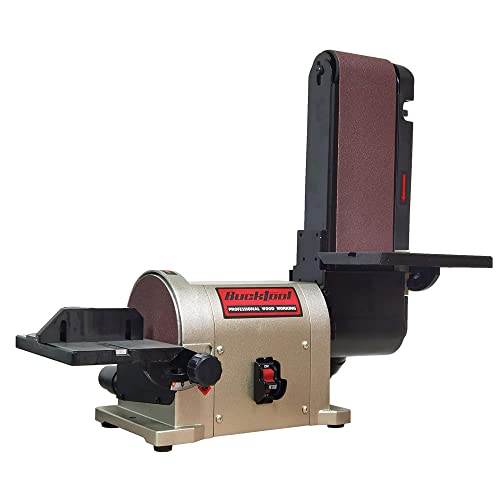
Bucktool 4x36 Belt and 6-Inch Disc Sander
Best for: Small workshop woodworking tasks
- Belt Size
- 4" x 36" (what this guide is about)
- Disc Diameter
- 6 in.
- Motor Power
- 3/4 HP
- Amperage
- 5A
- Belt Speed
- 2161 FPM
- Disc Speed
- 3450 RPM
View on Amazon: Bucktool 4x36 Belt and 6-Inch Disc Sander Affiliate link
This benchtop sander combines a 4 x 36-inch belt with a 6-inch disc. It uses a 3/4 HP motor that drives both surfaces directly, saving maintenance time. The belt tilts from 0 to 90 degrees for angled work. You get two cast aluminum tables and a sturdy base to reduce vibration. It fits woodworkers who want a compact, two-in-one machine for detailed shaping and flat sanding.
Pros
- Direct motor drive eliminates belt tension adjustments
- Belt tilts 0 to 90 degrees for angled sanding
- Includes two cast aluminum work tables
- Sturdy base with rubber feet reduces vibration
Cons
- 6-inch disc is smaller than the 8-inch option on this list
- 3/4 HP motor is less powerful than the 1 HP competitor
- Requires separate purchase of Y-fitting hose for dust collection
Good fit if
- You need a compact benchtop unit for small workshops
- You want to sand both flat and curved surfaces
- You prefer low-maintenance direct drive mechanics
Skip if
- You require high-power sanding for heavy material removal
- You need a larger 8-inch disc for wide surfaces
- You want an integrated dust collection system included
Verdict: Bucktool 4x36 Belt 6 Disc Sander offers a compact, low-maintenance solution for woodworkers who prioritize versatility over raw power. It suits those who need to switch between belt and disc tasks without taking up much bench space.

BUCKTOOL 1HP VFD 4x36 Belt 8 Disc Sander
Best for: Variable speed sanding on wood and metal
- Belt Size
- 4" x 36" (what this guide is about)
- Disc Diameter
- 8 in.
- Motor Power
- 1 HP
- Belt Speed
- 575–2300 SFPM
- Disc Speed
- 900–3600 RPM
- Configuration
- Benchtop
View on Amazon: BUCKTOOL 1HP VFD 4x36 Belt 8 Disc Sander Affiliate link
This benchtop sander combines a 4x36-inch belt with an 8-inch disc. It uses a 1 HP VFD motor for variable speed control from 900 to 3600 RPM. The belt runs at 575–2300 SFPM. You get precise angle adjustments with a 0–60° miter gauge and a 0–45° disc table. The memory function retains your speed settings. It suits users needing flexible speeds for wood or metal.
Pros
- 1 HP VFD motor delivers high torque at low speeds
- Variable speed range from 900 to 3600 RPM
- Supports horizontal and vertical belt sanding
- Speed memory function retains last used setting
Cons
- May trip GFCI outlets due to VFD motor
- 8-inch disc is smaller than the 6-inch standard on other models
- Requires HACR circuit breaker instead of standard outlets
Good fit if
- You need variable speed for different materials
- You require horizontal and vertical sanding options
- You want to save speed settings for repeated tasks
Skip if
- You only use GFCI protected outlets
- You prefer a larger 6-inch disc
- You need fixed speed simplicity
Verdict: Bucktool 1HP VFD 4x36 Belt 8 Disc Sander offers variable speed precision for detailed woodworking or metal projects. It fits users who need flexible RPM control and dual orientation sanding.
Specifications side by side
| Spec | Bucktool 4x36 Belt and 6-Inch Disc Sander | BUCKTOOL 1HP VFD 4x36 Belt 8 Disc Sander |
|---|---|---|
| Belt Size | 4 x 36 in. | 4 x 36 in. |
| Disc Diameter | 6 in. | 8 in. |
| Motor Power | 3/4 HP | 1 HP |
| Amperage | 5A | not stated |
| Belt Speed | 2161 FPM | 575–2300 SFPM |
| Disc Speed | 3450 RPM | 900–3600 RPM |
| Belt Tilt Range | 0 to 90 degrees | not stated |
| Configuration | Bench | Benchtop |
| Swing | not stated | 8-Inch |
| Speed Settings | not stated | Variable Speed |
| Features | Miter Gauge | not stated |
| Target Material | Wood | Wood |
| Cutting Width | 6-Inch | not stated |
| Application | Woodworking | Woodworking |
| Disc Size | 6-Inch Disc | not stated |
| Dimensions | 23.8 × 11.6 × 20.5 inches | 23.2 × 14.2 × 20.1 inches |
| Weight | 35.5 pounds | not stated |
| Size | 4x36in Belt & 6in Disc | 4" x 36" Belt & 8" Disc & 1HP VFD |
| Model | BD4603A | not stated |
Key Specs for Choosing Your Sander
-
Check disc size limits
Disc diameter determines the maximum curvature you can sand. The Bucktool 4x36 Belt and 6-Inch Disc Sander features a 6-inch cutting width. This suits general woodworking curves. The second model offers an 8-inch swing. This larger disc handles wider arcs and more aggressive shaping. Choose the 6-inch model for tight spaces and basic curves. Select the 8-inch version if you need more versatility for larger projects.
-
Compare motor amperage
Motor power affects how well the sander handles resistance. The first product uses a 5-amp motor. This is sufficient for light woodworking tasks in a small workshop. The second unit has a 1-HP motor. This provides more torque for demanding materials. If you sand softwoods occasionally, the 5-amp option works. For harder woods or metal, the 1-HP motor prevents stalling and maintains speed under load.
-
Assess speed control needs
Variable speed settings allow precision for different materials. The second Bucktool model includes a VFD with variable speed settings. This lets you adjust RPMs for delicate wood or metal sanding. The first model lacks this feature, offering fixed speed operation. If you only sand wood, fixed speed is adequate. If you switch between wood and metal, the variable speed control is essential for preventing burns and ensuring a clean finish.
-
Measure bench space
Footprint matters for benchtop machines. The top-rated sander measures 11.6 inches wide, 20.5 inches high, and 23.8 inches long. It weighs 35.5 pounds. This compact size fits small workbenches easily. The second model is larger due to its 1-HP motor and 8-inch disc. Check your available workspace before buying. If you have limited room, the smaller 6-inch disc model is the practical choice for storage and setup.
-
Verify belt compatibility
Both models use a 4 x 36-inch belt. This is a standard size for easy replacement. You do not need to search for obscure belt sizes. Ensure you buy belts that match this specific dimension. The belt size remains constant across both units. Focus your comparison on the disc size and motor power instead. This consistency simplifies maintenance and keeps operating costs predictable for both users.
Frequently asked questions
Which Bucktool sander is best for small woodworking tasks?
The Bucktool 4x36 Belt and 6-Inch Disc Sander is the top choice for small workshop projects. It features a compact design with a width of 11.6 inches. This model includes a 6-inch disc and a 4x36 belt. Its 5-amp motor provides sufficient power for light woodwork while saving bench space.
What is the difference between the two Bucktool sanders?
The first model has a 5-amp motor and a 6-inch disc, weighing 35.5 pounds. The second model offers a 1 HP VFD motor with variable speed settings. It features an 8-inch disc swing for more detailed work. The second unit is better for metal or precision tasks requiring RPM control.
Does the Bucktool sander support variable speed?
Only the second model supports variable speed. The BUCKTOOL 1HP VFD 4x36 Belt 8 Disc Sander includes variable speed settings. This allows you to adjust RPMs for different materials. The first model, the 6-Inch Disc Sander, does not list variable speed capabilities in its specifications.
What belt size do these sanders use?
Both sanders use a 4x36 belt size. This is a standard size for benchtop belt sanders. It fits common abrasive belts available at most hardware stores. The belt width is 4 inches, and the length is 36 inches for both the 6-inch and 8-inch disc models.
How wide is the disc on the top pick?
The top pick features a 6-inch disc. The Bucktool 4x36 Belt and 6-Inch Disc Sander has a cutting width of 6 inches. This size is suitable for general woodworking curves and flat surfaces. It is smaller than the 8-inch disc found on the second model.
Is the Bucktool sander heavy to move?
The top pick weighs 35.5 pounds. Its dimensions are 11.6 inches wide, 20.5 inches high, and 23.8 inches long. This weight provides stability during operation. The second model does not list a specific weight in the provided data, so its portability is unclear.
Can I sand metal with the Bucktool sander?
The second model is suitable for metal sanding. It is best for variable speed sanding on wood and metal. The 1 HP VFD motor allows for precise RPM adjustments needed for metal. The first model is targeted specifically at wood and may not be ideal for metal tasks.