Jet or VEVOR? Benchtop Planers Compared in 2026
As an Amazon Associate we earn from qualifying purchases. Links on this page are affiliate links.
This jet vs VEVOR benchtop planer comparison helps you choose between two 13-inch models. Both machines handle solid wood up to 6 inches thick and share a 13-inch cutting width. The main difference lies in their cutterheads and motor technology. One uses a helical head with 30 carbide inserts for quieter operation. The other relies on three high-speed steel blades driven by a dual-roller feed system. Each approach offers distinct benefits for different shop needs.
Key differences
| Aspect | JET 13-Inch Helical Benchtop Thickness Planer | VEVOR 13-Inch Three-Blade Benchtop Planer |
|---|---|---|
| Cutterhead Style | Helical with 30 carbide inserts | Three HSS blades |
| Motor Power | 2 HP, 15-amp | 2,000 W |
| Cutterhead Speed | 9,500 RPM | 23,500 RPM |
| Feed System | Standard feed | Dual-roller feeding system |
| Weight | 66 pounds | 62.8 pounds |
Which one should you choose?
Choose JET 13-Inch Helical Benchtop Thickness Planer if
- You want a quieter cut rated at 91 dB
- You prefer rotating individual carbide inserts when dull
- You need a depth stop for preset thicknesses
Choose VEVOR 13-Inch Three-Blade Benchtop Planer if
- You want dual rollers to reduce vibration on warped boards
- You prefer a higher cutterhead speed of 23,500 RPM
- You need a lighter machine at 62.8 pounds
Verdict: Choose the Jet if you prioritize a smoother, quieter cut and easier carbide maintenance. Pick the VEVOR if you need dual rollers for better stability on difficult stock. Both handle standard hardwoods well, so your choice depends on your preferred feed mechanism.
Jet vs VEVOR Planer Specs
cutterhead style
The Jet JWP-13BTHH features a helical cutterhead with 30 four-sided carbide inserts. This design shears wood for a smoother surface and operates at a rated 91 dB, which is quieter than its straight-knife counterpart. When an insert dulls, you rotate it to a fresh edge rather than replacing a full knife set, and five spare inserts are included. The VEVOR model uses a simpler three-blade HSS (High-Speed Steel) system. While effective for glass-smooth edges, HSS blades require more frequent sharpening or replacement compared to the modular carbide inserts found on the Jet unit.
motor speed
Motor performance differs significantly between these two benchtop planers. The Jet model turns its cutterhead at 9,500 RPM, paired with a 24.6 FPM feed rate. This setup allows for controlled material removal, taking up to 1/8 inch per pass on narrower boards. The VEVOR planer boasts a higher cutterhead speed of 23,500 RPM (or 24,000 CPM as noted in some descriptions) driven by a 2,000W motor. This higher speed targets hardwoods like oak and maple, aiming for uninterrupted cutting. The Jet offers a specific feed rate metric, while the VEVOR emphasizes raw rotational speed for handling dense materials.
feed system
How the machine advances the board affects cut quality. The VEVOR planer includes a dual-roller feeding system. These sturdy rollers advance boards with precision, reducing vibration and alignment issues to help prevent snipe and keep long or warped boards steady. The Jet JWP-13BTHH does not list a dual-roller system in its specifications. Instead, it relies on a standard feed mechanism with folding infeed and outfeed tables to support longer boards. The Jet does offer a four-post head support for stability, but it lacks the active roller feed found on the VEVOR model.
depth control
Precision adjustments matter for consistent results. The Jet planer uses a 1/16-inch-per-turn crank with a fine-increment dial for controlled height adjustment. It also includes an onboard depth-of-cut gauge and a depth stop preset for common thicknesses. The VEVOR model adjusts cutting depth in precise 1/8-inch increments with millimeter-level accuracy. While the Jet offers finer micro-adjustments via its crank mechanism, the VEVOR provides a straightforward incremental adjustment system. Both machines allow you to control how much material is removed, but the Jet’s dial offers potentially greater precision for fine-tuning.
dust compatibility
Both machines support standard shop dust collection setups. The Jet JWP-13BTHH features a dual-size dust port that fits both 4-inch and 2.5-inch hoses, with a recommended minimum airflow of 550 CFM. The VEVOR planer is also compatible with both 2-inch and 4-inch dust hoses to efficiently channel wood chips away. Neither product lists a specific CFM requirement or fan power rating in the provided data. Both designs aim to keep your workspace clean and minimize airborne dust. Since both accommodate the same hose sizes, they offer equal flexibility for connecting to your existing dust collection system.
weight and build
The physical footprint and weight influence stability and portability. The Jet planer weighs 66 pounds and measures 18.3 inches in width, 20.9 inches in height, and 25 inches in length. It includes carrying handles but requires two people to unbox. The VEVOR model is slightly lighter at 62.8 pounds, with a width of 13 inches, a height of 6 inches, and a length of 28.2 inches. The VEVOR’s larger worktable length supports longer boards more effectively. The Jet’s heavier base may offer slightly more stability during operation, while the VEVOR’s compact width saves bench space.
Choose the right planer for your needs
Quiet home shop users
The Jet model operates at a rated 91 dB, making it quieter than standard straight-knife versions. Its helical cutterhead with 30 carbide inserts shears wood smoothly. This design reduces noise significantly. You benefit from a cleaner cut and less disruption in shared spaces or small workshops where volume matters for comfort.
Precision hardwood workers
VEVOR features a dual-roller feeding system that advances boards with precision. This reduces vibration and alignment issues for straight cuts. The 2000W motor delivers 24,000 CPM, handling dense hardwoods like oak and maple effectively. You get glass-smooth edges free of splinters, ideal for high-volume projects demanding consistent, professional results.
Carbide maintenance fans
The Jet JWP-13BTHH includes 30 four-sided carbide inserts. When an edge dulls, you can rotate it 90 degrees to a fresh edge. This extends tool life significantly. Five spare inserts are included. You avoid replacing full knife sets, saving time and ensuring consistent performance. This system is built for serious hobbyists and finish carpenters.
The products compared

JET 13-Inch Helical Benchtop Thickness Planer
Best for: Wide solid wood planing in small workshops
- Cutting Width
- 13"
- Cutterhead Style
- Helical
- Blade Count
- 30 carbide inserts
- Maximum Stock Thickness
- 6"
- Feed Rate
- 24.6 FPM
- Motor Power
- 2 HP, 15A
View on Amazon: JET 13-Inch Helical Benchtop Thickness Planer Affiliate link
This Jet benchtop planer planes boards up to 13 inches wide and 6 inches thick. Its 2 HP motor drives a helical cutterhead with 30 carbide inserts at 9,500 RPM. The quiet 91 dB operation and fine crank adjustment suit serious hobbyists and small shops. It handles solid wood only, requiring boards at least 14 inches long.
Pros
- Helical cutterhead with 30 carbide inserts for a smoother surface
- Quiet 91 dB operation compared to straight-knife models
- Rotatable inserts allow edge refresh without full knife replacement
- Fine-increment crank dial with four-post head support
Cons
- Minimum board length of 14 inches limits workpiece options
- Reduced max cut depth to 1/16 inch on full-width stock
- Excludes plywood, painted lumber, and end grain processing
Good fit if
- You need a 13-inch capacity for wide hardwoods
- You prioritize quiet operation and fine surface finishes
- You work with solid wood boards longer than 14 inches
Skip if
- You frequently plane plywood or reclaimed painted lumber
- You require processing end grain or short stock
- You need a stationary machine for heavy daily use
Verdict: JET 13" Helical Benchtop Planer delivers precise, quiet planing for wide solid wood stock. It fits small shops needing 13-inch capacity without the footprint of a stationary unit.
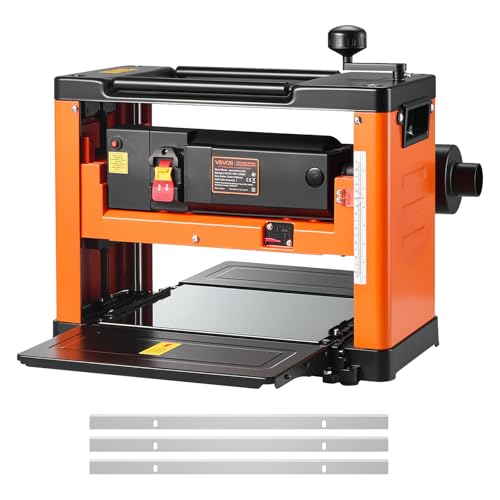
VEVOR 13-Inch Three-Blade Benchtop Planer
Best for: Users needing 13-inch width and dual rollers
- Cutting Width
- 13 in
- Blade Count
- 3 HSS blades
- Motor Power
- 2,000 W
- Swing
- 13-Inch
- Configuration
- Benchtop
- Target Material
- Wood
View on Amazon: VEVOR 13-Inch Three-Blade Benchtop Planer Affiliate link
This VEVOR benchtop planer features a 13-inch cutting width and a 2,000-watt motor. It uses a dual-roller feeding system with three HSS blades to reduce vibration. The worktable measures 28.2 inches long to support longer boards. It offers 1/8-inch depth adjustments and accepts 2-inch or 4-inch dust hoses. This machine suits users needing steady performance for hardwoods like oak or maple.
Pros
- 2,000-watt motor handles hardwoods
- Dual-roller feeding reduces vibration
- 28.2-inch worktable supports long boards
- Compatible with 2-inch and 4-inch dust hoses
Cons
- Single-speed operation limits versatility
- HSS blades require more frequent sharpening than carbide
- 62.8-pound weight is heavy for a benchtop unit
Good fit if
- You need a 13-inch width for wider stock
- You want dual rollers for smoother feeding
- You prefer HSS blades for easy sharpening
Skip if
- You require helical or spiral cutterheads
- You need two-speed motor options
- You want a lighter machine under 50 pounds
Verdict: VEVOR 13-Inch 3-Blade Benchtop Planer fits users who prioritize a wide 13-inch capacity and stable dual-roller feeding over the helical cutterhead found in higher-end models. It is a solid choice for those who do not need two-speed motor control.
Specifications side by side
| Spec | JET 13-Inch Helical Benchtop Thickness Planer | VEVOR 13-Inch Three-Blade Benchtop Planer |
|---|---|---|
| Cutting Width | 13" | 13 in |
| Cutterhead Style | Helical | not stated |
| Blade Count | 30 carbide inserts | 3 HSS blades |
| Maximum Stock Thickness | 6" | not stated |
| Feed Rate | 24.6 FPM | not stated |
| Motor Power | 2 HP, 15A | 2,000 W |
| Cutterhead Speed | 9,500 RPM | not stated |
| Voltage | 120V | not stated |
| Swing | not stated | 13-Inch |
| Configuration | Benchtop | Benchtop |
| Amperage | 15 Amp | not stated |
| Target Material | not stated | Wood |
| Dimensions | 25 × 18.3 × 20.9 inches | 28.2 × 13 × 6 inches |
| Weight | 66 pounds | 62.8 pounds |
| Color | White | Single Speed 3 Blade |
| Model | JWP-13BTHH | M1B-LS-3301 |
| Size | not stated | 33cm-2000(3 Blades) |
Frequently asked questions
Which benchtop planer is better for quiet operation?
The Jet JWP-13BTHH is the better choice for noise reduction. It features a helical cutterhead with 30 carbide inserts that shears wood smoothly. This design operates at a rated 91 dB, making it significantly quieter than standard straight-knife models. If you work in a shared space or home shop, this lower noise level is a major practical benefit.
Does the VEVOR planer have dual feed rollers?
Yes, the VEVOR 13-Inch Three-Blade Benchtop Planer includes dual rollers. This feature helps stabilize the wood during feeding, reducing the chance of kickback or uneven cuts. The dual-roller system provides consistent pressure on the stock, which is helpful for maintaining uniform thickness across wider boards up to 13 inches.
What is the size difference between the Jet and VEVOR models?
The Jet unit measures 25 inches in length, while the VEVOR model is 28.2 inches long. The Jet is also slightly heavier at 66 pounds compared to the VEVOR’s 62.8 pounds. Both are benchtop configurations, but the Jet’s shorter footprint may fit better in tighter workshop spaces.
Can these planers handle 13-inch wide boards?
Both machines are designed to handle wood up to 13 inches wide. The Jet model offers a 13-inch cutting capacity, and the VEVOR unit also specifies a 13-inch swing. This width allows you to plane wide solid wood stock, such as table tops or door panels, without needing to joint edges first.
Is the Jet planer suitable for small workshops?
Yes, the Jet JWP-13BTHH is ideal for small workshops. Its benchtop configuration and 25-inch length allow it to fit on standard workbenches without requiring a large stationary footprint. It delivers precise planing for wide stock while maintaining a compact size that suits limited floor space.
What type of cutterhead does the VEVOR use?
The VEVOR 13-Inch model uses a straight-blade cutterhead with three blades. This is a traditional design that differs from the helical head found in higher-end models. While it may not offer the same level of surface smoothness as a helical head, it is a reliable option for users who prioritize dual rollers over cutterhead technology.