Jet 14" x 40" Variable vs Jet 16" x 40" EVS (2026): Key Differences
As an Amazon Associate we earn from qualifying purchases. Links on this page are affiliate links.
This comparison of the jet 14 x 40 variable vs 16 x 40 evs helps you choose the right wood lathe. Both machines handle woodturning with 40 inches between centers. They share cast iron bases for stability and variable speed controls. The main difference lies in the swing capacity and motor power. The 14-inch model offers a more compact footprint, while the 16-inch EVS provides greater capacity and electronic speed control.
Key differences
| Aspect | JET 14" x 40" Variable Speed Wood Lathe | JET 16" x 40" Variable Speed Wood Lathe |
|---|---|---|
| Swing Over Bed | 14 inches | 16 inches |
| Motor Power | 1 HP | 1-1/2 HP |
| Speed Control | Variable Speed (mechanical) | Electronic infinitely-variable |
| Voltage | 115/230V | 115V |
| Speed Range | 400 - 3,000 RPM | 40 - 3,200 RPM |
| Weight | 352 pounds | 377 pounds |
Which one should you choose?
Choose JET 14" x 40" Variable Speed Wood Lathe if
- You need a lathe that runs on either 115V or 230V power.
- You prefer a lighter machine that is easier to move.
- You typically turn smaller diameter stock under 14 inches.
Choose JET 16" x 40" Variable Speed Wood Lathe if
- You require precise electronic speed adjustments for fine detail work.
- You need to turn larger diameter stock up to 16 inches.
- You want a more powerful 1-1/2 HP motor for heavy cuts.
Verdict: Choose the 14-inch model if you value dual-voltage flexibility and a lighter weight. The 16-inch EVS is better for those needing higher capacity and smoother electronic speed control. Both machines offer the same 40-inch turning length between centers.
Comparing JET 14 and 16 Inch Lathes
Swing Capacity
The JET 16" x 40" EVS offers a 16-inch swing over the bed, while the 14" x 40" Variable model provides a 14-inch swing. This two-inch difference matters if you plan to turn larger bowls or wide blanks. A larger swing allows you to work with more substantial stock without needing to trim it down first. If your projects frequently involve wide diameters, the EVS model gives you more room. For smaller spindle work, both machines handle the task well. Choose based on the maximum diameter of your typical projects.
Motor Power
Power output differs between these two lathes. The 16" x 40" EVS is equipped with a 1-1/2 HP motor. In contrast, the 14" x 40" Variable Speed model uses a 1 HP motor. Higher horsepower allows the lathe to maintain speed under heavier loads, such as when roughing out large green wood blanks. If you tackle dense hardwoods or large diameters often, the extra power in the EVS model helps prevent stalling. For light turning or established dry wood, both motors perform adequately.
Speed Range
Speed control varies significantly between the two models. The 14" x 40" Variable Speed lathe operates between 400 RPM and 3,000 RPM. The 16" x 40" EVS model offers an electronic infinitely-variable range from 40 RPM to 3,200 RPM. The lower minimum speed of 40 RPM on the EVS is crucial for turning large-diameter bowls safely. Higher maximum speed on the EVS aids in finishing small items. The variable control on the 14-inch model is manual, requiring belt changes or knob adjustments depending on the specific mechanism, whereas the EVS uses an electronic inverter.
Voltage Requirements
Electrical needs differ for these machines. The 14" x 40" Variable Speed lathe supports dual voltage: 115V or 230V. This flexibility allows you to plug it into a standard outlet or a dedicated 230V circuit. The 16" x 40" EVS model is listed strictly as 115V. If your workshop only has standard 115V outlets, the EVS is ready to go. However, if you have 230V capability, the 14-inch model can utilize it for potentially better performance or future-proofing. Check your shop's electrical setup before purchasing.
Physical Dimensions
Footprint and weight differ notably. The 14" x 40" model is wider at 58 inches and taller at 39 inches, weighing 352 pounds. The 16" x 40" EVS is more compact in width at 31 inches and height at 28 inches, but heavier at 377 pounds. The EVS’s narrower width may fit better in tighter shop spaces. The 14-inch model’s open stand design might offer easier access from the sides. Consider your available floor space and whether you need a more compact footprint or a wider stable base.
Which JET Lathe Fits Your Workshop
Turning large diameter bowls and platters
The JET 16" x 40" EVS offers a 16-inch swing over the bed. This extra two inches of capacity allows you to turn larger workpieces that would not fit on the 14-inch model. The 1-1/2 HP motor provides more power for heavy cuts. The electronic variable speed control offers precise adjustments from 40 to 3200 RPM for different wood types.
Needing dual voltage flexibility for shop
The JET 14" x 40" Variable supports both 115V and 230V operation. This dual voltage capability gives you more flexibility in how you wire the machine to your shop power. It also includes an open stand design. The variable speed range of 400 to 3,000 RPM covers most standard woodworking turning requirements effectively.
Prioritizing compact footprint and portability
The JET 16" x 40" EVS has a smaller physical footprint with dimensions of 31 inches wide by 57 inches long. This makes it easier to fit in tighter workshop spaces compared to the larger 14" model. Despite its smaller size, it retains the 40-inch between-centers length for long turning projects while saving floor space.
Wanting heavy duty cast iron stability
The JET 14" x 40" Variable features a robust cast iron base that ensures minimal vibration during operation. Weighing 352 pounds, this machine provides a solid foundation for precise turning. The stable design helps maintain accuracy when working with dense hardwoods or performing detailed spindle work that requires consistent speed and minimal shake.
The products compared

JET 14" x 40" Variable Speed Wood Lathe
Best for: Woodworkers needing stable manual speed control
- Swing Over Bed
- 14"
- Between Centers
- 40"
- Motor Power
- 1 HP
- Speed Range
- 400 RPM - 3,000 RPM
- Speed Control
- Variable Speed
- Voltage
- 115/230V
View on Amazon: JET 14" x 40" Variable Speed Wood Lathe Affiliate link
The Jet 14 x 40 Variable Speed Lathe is a 1 HP woodworking machine designed for precision turning. It offers a 14-inch swing and 40 inches between centers. The variable speed range of 400 to 3,000 RPM allows you to adjust cutting speeds for different materials. Its cast iron base reduces vibration. This model suits woodworkers who need a stable, versatile lathe for various project sizes.
Pros
- Variable speed from 400 to 3,000 RPM
- 1 HP motor for consistent power
- 36 indexing positions with 7 positive locks
- Cast iron base for stability
Cons
- 14-inch swing is smaller than the 16-inch alternative
- 352-pound weight requires a sturdy floor
- No electronic variable speed (EVS) control
Good fit if
- You need a 14-inch swing capacity
- You prefer manual speed adjustment
- You want a heavy, stable cast iron base
Skip if
- You require more than 14 inches of swing
- You need electronic variable speed control
- You prefer a lighter, portable unit
Verdict: Jet 14 x 40 Variable Speed Lathe is a solid choice for woodworkers who prioritize stability and manual control over electronic speed adjustments. It fits those who do not need the extra swing capacity of larger models.
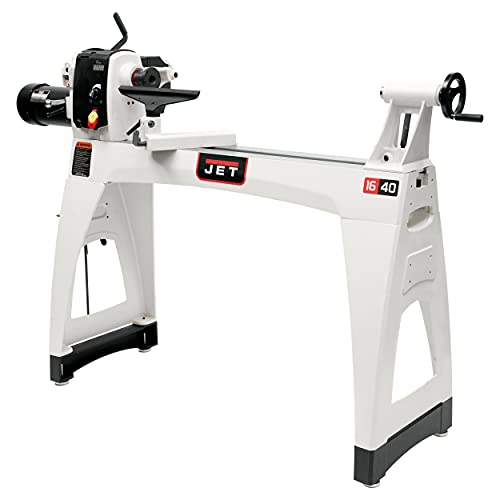
JET 16" x 40" Variable Speed Wood Lathe
Best for: Serious woodturners needing electronic speed control
- Swing Over Bed
- 16"
- Between Centers
- 40"
- Motor Power
- 1-1/2 HP
- Speed Range
- 40 to 3200 RPM
- Speed Control
- Electronic infinitely-variable
- Voltage
- 115V
View on Amazon: JET 16" x 40" Variable Speed Wood Lathe Affiliate link
This Jet lathe offers 16 inches of swing and 40 inches between centers. It features a 1-1/2 HP motor with electronic variable speed from 40 to 3200 RPM. The design includes an extended spindle nose and an improved tailstock quill with anti-rotation locking. It weighs 377 pounds and measures 57 inches long. You should choose this model if you need precise speed control and a robust build for serious woodturning projects.
Pros
- Electronic infinitely-variable speed from 40 to 3200 RPM
- 1-1/2 HP motor provides strong turning power
- Extended spindle nose houses dual headstock bearings
- Improved tailstock quill locking mechanism with anti-rotation key
Cons
- Weighs 377 pounds, making it difficult to move
- Requires 115V single-phase power connection
- Does not include a variable speed dial for manual adjustment
Good fit if
- You need precise speed control for detailed woodturning
- You have a dedicated space for a heavy machine
- You work with larger diameter stock up to 16 inches
Skip if
- You need a portable lathe for job sites
- You only work with small turning projects
- You require a 230V power connection
Verdict: Jet 16 x 40 EVS Lathe delivers professional-grade stability and speed control for serious woodturners. It suits users who prioritize electronic precision and heavy-duty construction over portability.
Specifications side by side
| Spec | JET 14" x 40" Variable Speed Wood Lathe | JET 16" x 40" Variable Speed Wood Lathe |
|---|---|---|
| Swing Over Bed | 14" | 16" |
| Between Centers | 40" | 40" |
| Motor Power | 1 HP | 1-1/2 HP |
| Speed Range | 400 RPM - 3,000 RPM | 40 to 3200 RPM |
| Speed Control | Variable Speed | Electronic infinitely-variable |
| Voltage | 115/230V | 115V |
| Swing | 14-Inch | not stated |
| Speed Settings | Variable Speed | Variable Speed |
| Target Material | Wood | Wood |
| Application | Woodworking, Woodturning | Woodworking, Woodturning |
| Dimensions | 88 × 58 × 39 inches | 57 × 31 × 28 inches |
| Weight | 352 pounds | 377 pounds |
| Color | White | White |
| Model | JWL-1440VSK | JWL-1640EVS |
Frequently asked questions
Does the Jet 14 x 40 Variable have a motor that matches the 16-inch model?
No, the motor power differs between the two machines. The 14-inch Variable Speed model is equipped with a 1 HP motor. In contrast, the 16-inch EVS model features a more powerful 1-1/2 HP motor. You should choose the larger motor if you plan to turn dense hardwoods or require higher torque for heavy cuts.
Can I plug either lathe into a standard 115-volt outlet?
Yes, both lathes support 115-volt operation. The 14-inch Variable Speed model offers dual voltage capability, allowing you to run it on 115V or 230V. The 16-inch EVS model is listed with 115V compatibility. You can install either machine in a standard workshop circuit without needing specialized high-voltage wiring for basic operation.
Which lathe weighs more and is harder to move?
The 16-inch EVS model is heavier at 377 pounds. The 14-inch Variable Speed model weighs 352 pounds. This extra weight in the 16-inch unit provides greater stability during heavy turning but makes it significantly harder to reposition. You will need adequate floor space and potentially a dolly to move either machine safely.
What are the physical dimensions of the Jet 14 x 40 Variable?
The 14-inch model measures 88 inches in length, 58 inches in width, and 39 inches in height. It weighs 352 pounds. You must ensure your workshop has enough floor space to accommodate this footprint. The larger 16-inch model is shorter at 57 inches long but still requires a substantial dedicated area for safe operation.
Is the color different between the two Jet lathe models?
No, both machines share the same exterior finish. The 14-inch Variable Speed model is painted white. The 16-inch EVS model is also finished in white. This consistent color scheme helps them blend together if you eventually add both to your workshop, though their functional differences remain distinct for different turning needs.
Are these machines suitable for professional woodturning applications?
Yes, both are designed for woodworking and woodturning tasks. The 16-inch EVS model is specifically noted for professional-grade stability and electronic precision. The 14-inch model is a solid choice for woodworkers who prioritize manual control. You can use either for serious turning projects, provided you select the one that matches your required swing capacity and control preferences.