13-Inch vs 20-Inch Benchtop Planers: Which Should You Buy?
As an Amazon Associate we earn from qualifying purchases. Links on this page are affiliate links.
Choosing between a 13-Inch vs 20-Inch benchtop planer depends on your shop space and project scale. Both machines handle hardwoods like oak and maple, delivering smooth surfaces for woodworking projects. The main difference lies in capacity and power. The smaller model offers a compact footprint with a 2,000W motor, while the larger unit provides a 5 HP helical cutterhead for wider boards. You must decide which fit matches your workflow and available electrical supply.
Key differences
| Aspect | VEVOR 13-Inch Three-Blade Benchtop Planer | JET 20-Inch 5 HP Helical Planer |
|---|---|---|
| Swing | 13-Inch | 20-Inch |
| Motor Power | 2,000 W | 5 HP |
| Cutterhead Style | 3 HSS blades | Helical |
| Voltage | not listed | 230V 1Ph |
| Feed Rate | not listed | 24/31 fpm |
| Weight | 62.8 pounds | 753 pounds |
Which one should you choose?
Choose VEVOR 13-Inch Three-Blade Benchtop Planer if
- You need a planer that fits on a standard workbench due to its 62.8-pound weight.
- You primarily plane boards up to 13 inches wide and want a simpler blade setup.
- You require a machine compatible with standard 2-inch or 4-inch dust hoses.
Choose JET 20-Inch 5 HP Helical Planer if
- You frequently plane wide boards up to 20 inches across.
- You have a 230V electrical circuit and need a heavy-duty 5 HP motor.
- You want precise feed rate control with two-speed options for different wood types.
Verdict: The VEVOR suits hobbyists with limited space and standard voltage needs. The JET is built for serious woodworkers requiring wide capacity and industrial power. Your choice depends on whether board width or motor strength is the priority.
Comparing 13-Inch vs 20-Inch Planers
Cutting Width
The VEVOR 13-Inch Three-Blade Benchtop Planer offers a 13-inch cutting width, suitable for standard lumber and smaller boards. The JET 20-Inch 5 HP Helical Planer provides a significantly wider 20-inch cutting width. This difference determines the maximum board size you can process in a single pass. If you frequently work with wide panels or large slabs, the JET model handles them without needing to join narrower pieces. The VEVOR is better for narrower stock. This spec is the primary factor in choosing between the two machines based on your typical project dimensions.
Motor Power
Power output varies drastically between these two units. The VEVOR planer features a 2,000-watt motor, which delivers sufficient power for general woodworking tasks and lighter duty work. In contrast, the JET planer is equipped with a 5 HP motor. Since one horsepower equals approximately 746 watts, the JET motor provides roughly 3,730 watts of power. This substantial difference means the JET can maintain speed under heavier loads and tougher hardwoods more effectively. The VEVOR may struggle or bog down when taking deep cuts in dense material. For heavy-duty use, the JET is superior.
Configuration
The VEVOR is explicitly labeled as a benchtop configuration, designed to sit on a workbench or sturdy table. This makes it portable and space-efficient for smaller shops. The JET model is a floor-standing machine, indicated by its massive 753-pound weight and large footprint. It requires a dedicated floor space and cannot be moved easily. If you have limited shop space or need to store the machine when not in use, the VEVOR’s benchtop design is advantageous. However, the JET’s floor-standing build offers greater stability and vibration dampening during operation due to its mass.
Feed Speed
Speed settings affect surface finish and efficiency. The JET planer includes a two-speed gearbox offering feed rates of 24 and 31 feet per minute. This allows you to adjust the feed speed based on the wood type and desired finish, optimizing performance for different materials. The VEVOR planer data lists a single speed configuration. While it provides a consistent cutting pace, it lacks the flexibility to slow down for delicate or figured wood. The JET’s adjustable feed rates provide more control over the planing process, making it more versatile for various woodworking needs.
Cutterhead Style
The cutting tool design impacts the finish quality and blade maintenance. The VEVOR uses a traditional style with three HSS blades. This setup is common and allows for easy blade replacement, but it may produce slight tear-out on figured woods. The JET planer features a helical cutterhead. This design uses multiple small carbide inserts arranged in a spiral pattern. Helical heads generally provide a smoother finish with less tear-out and produce less noise. The inserts also rotate, so you can index them when dull, extending the life of the cutting elements. The JET offers a superior cutting mechanism for finish work.
Which Planer Fits Your Shop
Small shop owners with limited space
The VEVOR model weighs 62.8 pounds and fits on a benchtop. Its 13-inch width handles standard lumber without consuming floor space. The compact design suits workshops where mobility and storage are priorities. You gain precise 1/8-inch depth control and dual-roller feeding for stable operation on smaller boards.
Professionals planing wide boards regularly
The JET planer offers a 20-inch cutting width, accommodating wider stock than the 13-inch alternative. Its 5 HP motor and helical cutterhead provide robust performance for heavy-duty tasks. The 753-pound weight ensures stability during aggressive planing. You benefit from two-speed feed rates and precise 1/16-inch adjustments.
Users needing precise fine adjustments
The JET model features a 1/16-inch increment height scale for highly precise cuts. Its large handwheel with positive gear drive allows quick, accurate table adjustments. The magnetic controls add reliability. While heavier, this precision and control make it ideal for detailed work where fine-tuning thickness is critical for the final finish.
Quick picks
| # | Product | Best for | Price |
|---|---|---|---|
| 1 | VEVOR 13-Inch Three-Blade Benchtop Planer | Standard-width hardwoods and compact workshops | Check price of VEVOR 13-Inch Three-Blade Benchtop Planer on Amazon |
| 2 | JET 20-Inch 5 HP Helical Planer | Wide stock and heavy-duty precision planing | Check price of JET 20-Inch 5 HP Helical Planer on Amazon |
The products compared
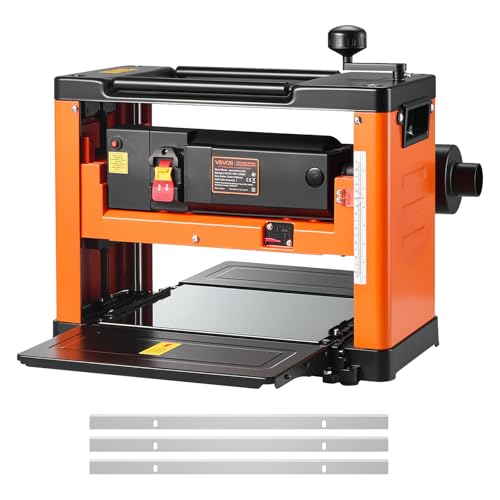
VEVOR 13-Inch Three-Blade Benchtop Planer
Best for: Standard-width hardwoods and compact workshops
- Swing
- 13-Inch (what this guide is about)
- Cutting Width
- 13 in
- Blade Count
- 3 HSS blades
- Motor Power
- 2,000 W
- Configuration
- Benchtop
- Target Material
- Wood
View on Amazon: VEVOR 13-Inch Three-Blade Benchtop Planer Affiliate link
This VEVOR benchtop planer offers a 13-inch cutting width for standard lumber. It uses a 2,000-watt motor to drive three HSS blades at up to 24,000 CPM. The dual-roller feed system helps reduce snipe and vibration on long boards. With 1/8-inch precision depth control, you get consistent results for hardwoods like oak and maple. It weighs 62.8 pounds and fits on your workbench.
Pros
- 13-inch cutting width handles most common board sizes
- Dual-roller feeding system reduces snipe and vibration
- 2,000-watt motor provides 24,000 CPM for hardwoods
- 1/8-inch precision depth control ensures repeatable cuts
Cons
- Single-speed motor limits feed rate options
- 13-inch width cannot handle 20-inch wide stock
- 3-blade HSS head may leave more marks than helical designs
Good fit if
- You need a compact planer for standard 13-inch wide lumber
- You prioritize a stable feed system for long boards
- You work with hardwoods like oak and maple
Skip if
- You regularly plane boards wider than 13 inches
- You require a helical cutterhead for quieter operation
- You need variable speed feed control
Verdict: VEVOR 13-Inch 3-Blade Benchtop Planer suits woodworkers who need a reliable, space-saving tool for standard-width hardwoods. Its dual-roller system and precise depth control make it a solid choice for consistent finishes on common lumber sizes.

JET 20-Inch 5 HP Helical Planer
Best for: Wide stock and heavy-duty precision planing
- Swing
- 20-Inch (what this guide is about)
- Cutting Width
- 20-Inch
- Cutterhead Style
- Helical
- Feed Rate
- 24/31 fpm
- Motor Power
- 5 HP
- Voltage
- 230V 1Ph
View on Amazon: JET 20-Inch 5 HP Helical Planer Affiliate link
The JET JWP-208HH is a 20-inch benchtop planer with a 5 HP motor and helical cutterhead. It runs on 230V single-phase power. You get two feed speeds: 24 and 31 feet per minute. The machine weighs 753 pounds and sits on a welded steel base. This heavy-duty tool suits serious woodworkers needing wide cuts and precise adjustments.
Pros
- 20-inch cutting width for wide boards
- 5 HP TEFC induction motor
- Helical cutterhead for smoother cuts
- Two-speed feed rate at 24/31 fpm
- 1/16-inch height scale for precision
Cons
- Requires 230V single-phase power
- Weighs 753 pounds for heavy stability
- Large footprint at 36.7 inches wide
Good fit if
- You need to plane boards up to 20 inches wide
- You have a dedicated 230V outlet in your shop
- You want a heavy, stable machine for fine adjustments
Skip if
- You only have standard 115V household outlets
- You lack floor space for a 753-pound machine
- You primarily work with narrow lumber under 13 inches
Verdict: JET 20-Inch Planer 5 HP Helical is a robust solution for wide stock. It fits shops with 230V power and ample floor space for its massive frame.
Specifications side by side
| Spec | VEVOR 13-Inch Three-Blade Benchtop Planer | JET 20-Inch 5 HP Helical Planer |
|---|---|---|
| Cutting Width | 13 in | 20-Inch |
| Cutterhead Style | not stated | Helical |
| Blade Count | 3 HSS blades | not stated |
| Feed Rate | not stated | 24/31 fpm |
| Motor Power | 2,000 W | 5 HP |
| Voltage | not stated | 230V 1Ph |
| Swing | 13-Inch | 20-Inch |
| Configuration | Benchtop | not stated |
| Target Material | Wood | not stated |
| Dimensions | 28.2 × 13 × 6 inches | 26 × 36.7 × 41.4 inches |
| Weight | 62.8 pounds | 753 pounds |
| Size | 33cm-2000(3 Blades) | not stated |
| Color | Single Speed 3 Blade | White |
| Model | M1B-LS-3301 | JWP-208HH |
Frequently asked questions
Can a 13-inch planer handle standard 2x4 lumber?
Yes, a 13-inch planer can handle standard 2x4 lumber. The VEVOR 13-Inch Three-Blade Benchtop Planer offers a 13-inch cutting width. This capacity is suitable for standard-width hardwoods and common lumber sizes. It provides consistent finishes for typical woodworking projects without requiring excessive shop space.
What is the weight difference between these two models?
The weight difference is significant. The VEVOR 13-Inch model weighs 62.8 pounds. The JET 20-Inch 5 HP Helical Planer weighs 753 pounds. This massive difference means the smaller unit stays on a benchtop, while the larger unit requires substantial floor support and permanent placement.
Does the 20-inch planer require special electrical wiring?
Yes, the 20-inch planer typically requires special wiring. The JET 20-Inch 5 HP Helical Planer operates on 230V power. Most standard home outlets provide 120V. You must verify your shop has the correct voltage circuit before purchasing this heavier, high-power model to ensure safe operation.
Which planer is better for small workshops?
The 13-inch planer is better for small workshops. The VEVOR model measures 28.2 inches in length and fits on a benchtop. Its compact design suits workshops where mobility and storage are priorities. The larger 20-inch unit requires ample floor space and cannot be easily moved or stored.
What cutterhead style does the JET planer use?
The JET planer uses a helical cutterhead. This style is designed for heavy-duty precision planing. It handles wide stock effectively. The helical design generally offers quieter operation and longer blade life compared to traditional straight knives, making it suitable for serious woodworking tasks.
Is the VEVOR planer single-speed or variable-speed?
The VEVOR planer is single-speed. Its specifications list it as a Single Speed 3 Blade model. This configuration provides consistent feed rates for standard-width hardwoods. It is a solid choice for woodworkers who need a reliable tool without the complexity of variable speed controls.